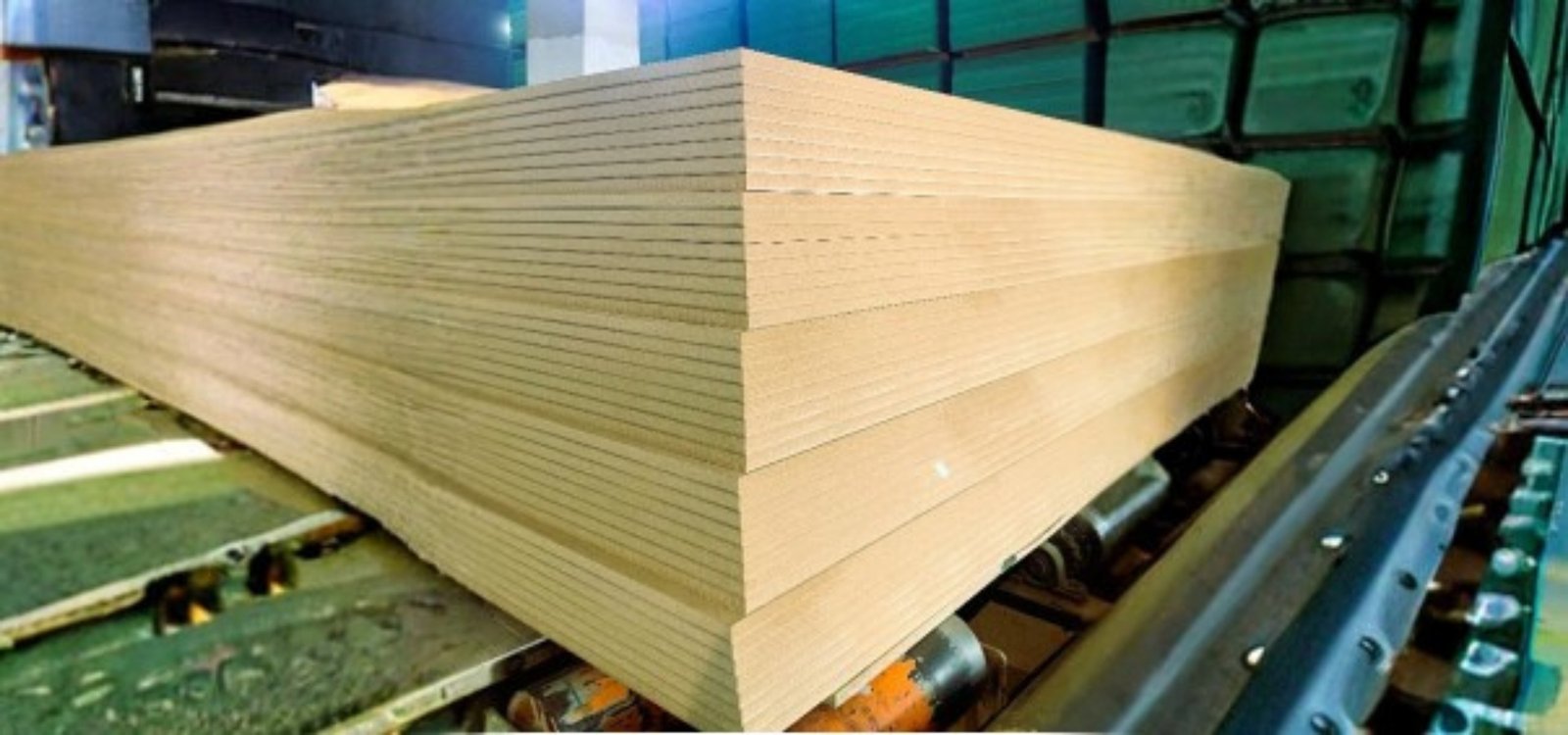
India’s MDF (Medium Density Fibreboard) industry is relatively young but has evolved rapidly over the past three decades. The country’s first MDF manufacturing facility was established in 1996 by Nuchem Limited using advanced technology. At the time, MDF was largely unfamiliar to Indian consumers, who traditionally preferred plywood and solid wood. Limited awareness and entrenched material preferences resulted in slow initial adoption.
A significant turning point came in 2010 with the commissioning of an MDF plant by Greenpanel Industries, when India’s total MDF production capacity stood at just 0.15 million cubic metres. Since then, the industry has witnessed exponential growth, with installed capacity expanding more than twentyfold to approximately 4.2 million cubic metres by 2025. Capacity utilisation currently averages around 80%, supplemented by limited imports of about 0.35 million cubic metres annually.
Today, there are nearly 35 manufacturing units in India. The Indian MDF market is valued at over ₹5,000 crore and is among the fastest-growing segments within the wood-based panel industry. Organised manufacturers account for nearly 65% of domestic consumption and continue to replace imports through capacity expansion and product innovation. MDF is positioned as a cost-effective alternative to low- and medium-grade plywood, typically priced 30–35% lower, while offering a smooth surface, uniform texture, and dimensional stability.
Globally, MDF dominates panel consumption with an MDF-to-plywood ratio of approximately 70:30. In contrast, India’s ratio remains skewed at around 20:80, indicating substantial headroom for growth. This imbalance is expected to gradually correct toward 50:50 as MDF gains wider acceptance, particularly in furniture, cabinetry, interior applications, and office partitions where moisture and impact resistance are not critical.
The industry’s growth outlook remains strong. India’s MDF market is projected to grow at a CAGR of 15–20% over the coming years, supported by rising urbanisation, increasing disposable incomes, and growing demand for modern furniture and interior solutions. Organised players are expanding into value-added segments such as pre-laminated, high-density, moisture-resistant, and fire-retardant MDF, further broadening applications and improving margins. Demand momentum is expected to strengthen, with volumes projected to grow by 12–15% annually in the near term.
Structural entry barriers continue to favour organised manufacturers due to the capital-intensive nature of MDF production, long gestation periods to achieve optimal utilisation, regulatory approvals, extensive dealer networks, and the need for assured, cost-efficient raw material sourcing.
Technological advancement is also playing a key role in the industry’s evolution. Automated production lines and computer-controlled processing systems are improving output, consistency, and quality. At the same time, increasing use of agro-forestry wood is strengthening the sustainability profile of MDF manufacturing. Expansion of agro-forestry-based processing units near plantation areas not only enhances green cover but also provides farmers with supplementary income, generates rural employment, reduces migration to urban centres, and contributes to more balanced regional development.
Overall, India’s MDF industry is transitioning from a niche product segment to a mainstream engineered panel solution, supported by strong fundamentals, favourable cost dynamics, technological progress, and sustainable raw material availability.
Specification for Fibre Insulation Boards
Fibre hardboards - Specification
Medium Density Fibre Boards of Wood and Other Lignocellulosic Materials for General Purpose - Specification
Prelaminated Medium Density Fibre Boards of Wood and Other Lignocellulosic Materials - Specification
Medium Density Coir boards for General Purposes
